

Deep cut
Tuesday, October 13, 2026
Duffy's Cut
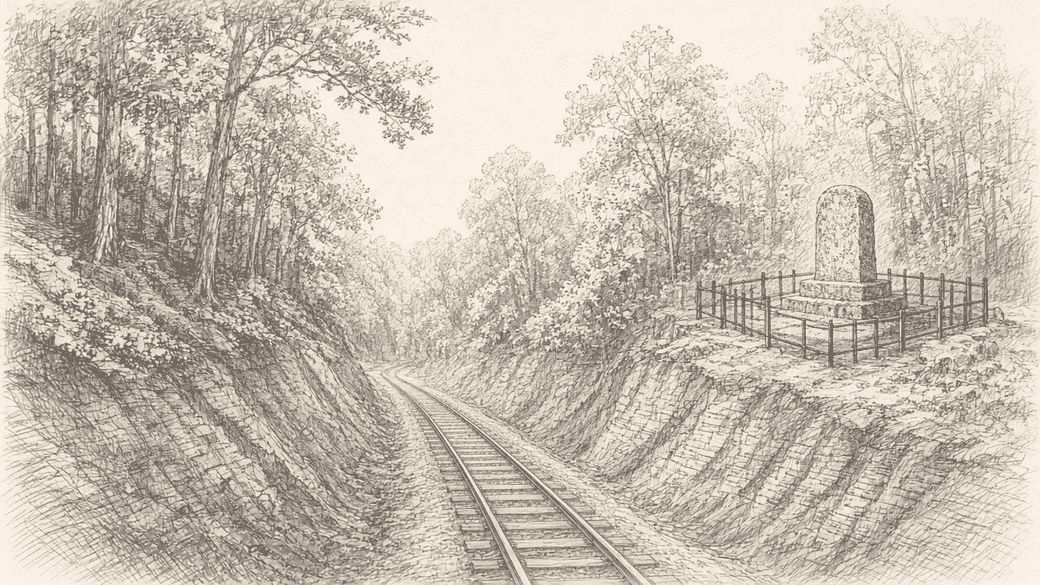
I first stopped at the Duffy's Cut marker the way most people probably do. I was driving King Road outside Malvern, saw the blue and gold state sign at Sugartown Road, and pulled over because I had never heard of the place.
I first stopped at the Duffy's Cut marker the way most people probably do. I was driving King Road outside Malvern, saw the blue and gold state sign at Sugartown Road, and pulled over because I had never heard of the place. While I was reading it, a train went by somewhere through the trees. That is when it landed. The grave the sign is talking about is right there, beside the tracks that train was riding.
The marker, dedicated in 2004, says it plainly: "Nearby is the mass grave of fifty-seven Irish immigrant workers who died in August, 1832, of cholera." It says they worked for a contractor named Duffy on the Philadelphia and Columbia Railroad, and that prejudice against Irish Catholics contributed to the denial of care to the workers.
That sign is where the story starts for most of us. It is not where Duffy's Cut stops. This week is a good one to learn it, because West Goshen Township is hosting a talk on the Duffy's Cut Railroad Workers Massacre on Thursday Oct 22 at 7pm, at the township building, 1025 Paoli Pike.
Why there was a cut at all
Duffy's Cut exists because of a hill. In 1832 the state was building the Philadelphia and Columbia Railroad west from the city, and the line had to get through the wooded hills and ravines around what is now East Whiteland. Trains cannot climb much, so somebody had to dig a level path through the high ground and fill in the low spots. That stretch near Malvern went to a railroad contractor named Philip Duffy.
Duffy hired 57 Irishmen to do it. According to the Duffy's Cut Project at Immaculata University, they were recent arrivals from the Ulster counties of Donegal, Tyrone, and Derry, hired that June, fresh off the ship in Philadelphia. They dug Duffy's Cut by hand and lived in a shanty camp beside the work.
The cut they made is still in use. The line later became part of the Pennsylvania Railroad's Main Line, and today it is part of Amtrak's busy line past Malvern, with trains through Duffy's Cut every day.
The summer cholera came to the camp
That same summer, the second cholera pandemic reached the region. Cholera spreads through dirty water, kills fast, and in 1832 nobody understood it. People were scared, and a lot of that fear landed on poor Irish Catholic immigrants, who were already treated as disposable labor and as a danger to everybody else.
At Duffy's Cut, the men started getting sick. Within about two months, the records suggest, all 57 were dead. The marker blames cholera and says prejudice helped deny them care. They were buried right there beside the cut, in a mass grave with no names on it. The railroad kept building. Duffy's Cut was finished by other hands, and the line opened.
For more than a century and a half, that was almost the entire story, and most of it was not public at all.
The file that kept Duffy's Cut alive
The records of the deaths at Duffy's Cut sat in Pennsylvania Railroad files for decades. After the railroad's 1970 bankruptcy, a man named Joseph Tripican, a secretary to a former railroad president, took the papers home. In the 1990s his grandson, Rev. Dr. Frank Watson, found them.
Frank brought the file to his brother, Dr. William Watson, a history professor at Immaculata, a few miles from the cut. With fellow Immaculata faculty Earl Schandelmeier and John Ahtes, they started the Duffy's Cut Project. They pushed for the state marker, which went up at King and Sugartown on June 18, 2004. That August, they started digging.
What the ground said
The dig ran near the active tracks, which made it slow work. On March 20, 2009, the team found the first human bones: two skulls, teeth, and dozens of other bones. Over the next few years they recovered remains from seven people near the old shanty site, along with artifacts like clay pipes the workers would have smoked during breaks from the cut.
Then came the hard part. Janet Monge of the Penn Museum helped analyze the remains, and some of the skulls showed signs of trauma. The project's view, featured in the PBS documentary "Death on the Railroad" in 2013, is that some of the people at Duffy's Cut did not die of cholera alone, and may have been killed, possibly out of fear of contagion. That is where the word "massacre" in this month's talk title comes from.
I want to be careful here, because Duffy's Cut deserves careful. Not everyone agrees. A local coroner who studied the bones, interviewed by Main Line Today in 2019, believes the damage came from decomposition and post-mortem damage, not violence. So what we know is this: 57 people died at the cut that summer, cholera was there, prejudice was there, and whether some were murdered is still argued by serious people. I think that open question is part of why this place still pulls at you.
Going home from Duffy's Cut
On March 9, 2012, the remains of five men and one woman recovered from the Duffy's Cut shanty site were buried with a religious service at West Laurel Hill Cemetery in Bala Cynwyd. One of the workers, identified as John Ruddy, was returned to Ireland for burial. Another, Catherine Burns, was also repatriated.
The rest are still there. Amtrak halted any deeper digging near the tracks, so most of the 57 are believed to remain under or beside the railroad they built. Every train through Duffy's Cut passes over them.
How to visit Duffy's Cut, the right way
Please do not go looking for the grave. It sits on an active Amtrak right of way, about 1,500 feet northeast of the marker, and it is dangerous and off limits. Here is what you can do instead.
Stand at the marker at King Road and Sugartown Road in East Whiteland, near Malvern. Read it. Listen for a train.
Visit the Duffy's Cut Museum in the Gabriele Library at Immaculata University, which holds artifacts from the dig. Check library hours before you go.
Go to the talk in West Goshen, Thursday Oct 22 at 7pm, 1025 Paoli Pike.
This is not a ghost story, even though it is October and it would be easy to tell it like one. Duffy's Cut is a real place where 57 people came to build something we still use and never got to leave. The least we can do is know their story the next time the train goes through.