

Deep cut
Tuesday, November 17, 2026
Paoli's two monuments
I've driven through Malvern more times than I can count, usually on my way somewhere else. It took me years to actually stop at the little park on Monument Avenue.
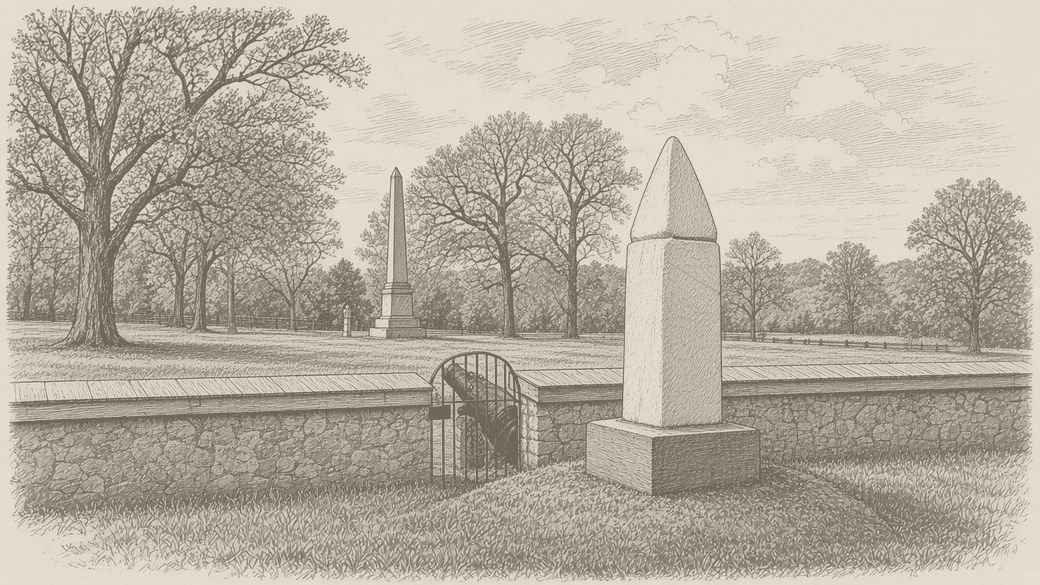
I've driven through Malvern more times than I can count, usually on my way somewhere else. It took me years to actually stop at the little park on Monument Avenue. Two memorials stand a few steps apart on a low mound, one small and weathered, one a tall granite obelisk, with a cannon by the iron gate. The park is open this week from sunrise to sundown, and it doesn't cost anything to walk in. I finally parked and did the loop.
The park on Monument Avenue
Paoli Battlefield Historical Park is in Malvern Borough, on Monument Avenue, Malvern, PA 19355. The Borough owns the park, about 40 acres, and the Paoli Battlefield Preservation Fund administers it. Next to it, the Paoli Memorial Association owns the gravesite, the memorials, and about 23 acres of parade grounds. The whole place is on the National Register of Historic Places, listed in 1997, on land roughly bounded by Warren and Monument Avenues and Sugartown Road. It is not a national park.
A shaded 3/4-mile trail takes you around with interpretive panels. I did it in an easy hour, including the time I spent standing at the monuments. There's no staffed tour listed for this week, so the path and the panels are the visit. Hours are sunrise to sundown. Stay out after dark. Dogs are welcome on a leash. Bikes are not allowed in the park, and neither is alcohol. It's a burial ground, and it reads that way once you're on the mound.
Why this Malvern field is called Paoli
The fight took its name from a tavern. The park you're standing in is in Malvern. In 1777 this stretch of the road toward Lancaster had inns at the milestones. One of them, about a mile from the field, was the General Paoli Inn, named in 1769 for a Corsican general. The Warren Inn was closer to the camp. The park's own FAQ says the Paoli name stuck anyway, and that the old inn burned in 1892, near where the Paoli post office is now. You visit the field in Malvern. You still hear it called Paoli, because that's the name the soldiers used.
The night of September 20, 1777
Nine days after the American loss at Brandywine Creek, on September 11, 1777, Washington was still trying to keep the British out of Philadelphia. On September 19, according to the park FAQ, he moved most of his troops to the north side of the Schuylkill and left Gen. Anthony Wayne on the south side, with orders to go after supply trains and avoid a full engagement.
On the night of September 20, British troops under Maj. Gen. Charles Grey came at Wayne's camp. Grey ordered the flints taken out of the muskets so a stray shot wouldn't give the column away. That order is how he picked up the nickname "No-Flint" Grey. The park FAQ says Wayne had actually been warned, twice, that an attack might be coming, and that he put out extra pickets.
What happened after that is still argued over. Americans called it the Paoli Massacre. The park FAQ says Wayne's men were standing at arms and pulling back when the British came in, and it also says the fighting was brutal enough that people here never treated it as an ordinary loss. I am not going to pretend I can settle that from a row of panels. Histories disagree on the totals. The number the park puts on the stones, and on its own pages, is this: 53 Americans are buried on the field.
The 1817 stone and the 1877 obelisk
In 1817, forty years later, a stone monument went up on the burial mound of those 53 soldiers. The park calls it the second oldest war memorial in the United States, and the oldest in Pennsylvania. I'm leaving the ranking to them. In 1877, on the 100th anniversary, a taller granite obelisk went up a few steps away.
I've seen write-ups that treat the 1877 obelisk as a replacement. I stood there and looked at both. The 1817 stone is still on the mound, inside a modern clear case that keeps the weather off the lettering. The 1877 obelisk is right there with it. That is the part I came for, two memorials to the same night, still sharing the same little rise.
"Remember Paoli" became a rallying cry after the fight, especially among Pennsylvania troops, according to the park. You can feel why, standing on the mound, even if you don't need to pick a side in the old argument about what to call it.
The park FAQ says the 1817 stone was dedicated on September 20, 1817, forty years to the day, in front of hundreds of citizens and Revolutionary War veterans, with militia in a slow solemn march. The parade grounds next to the gravesite later hosted memorial gatherings through the 1800s. I didn't come for a parade. I came to see how long this little rise has been a place people return to.
How to see it this week
The park is a short walk from Malvern's downtown, on Monument Avenue. Come during daylight. It's free. Wear shoes you don't mind getting damp if the grass is wet, and give yourself time for the 3/4-mile loop. There are no fires, no metal detectors, and no after-dark visits. I went on a quiet morning, read the panels, and stood at both monuments until the place settled in.
I used to think of Paoli as a train station and a name on a road sign. The field in Malvern is the reason the name stuck. The two monuments are still there, a few steps apart, if you actually stop.