
Deep cut
Tuesday, November 10, 2026
The iron that made Phoenixville
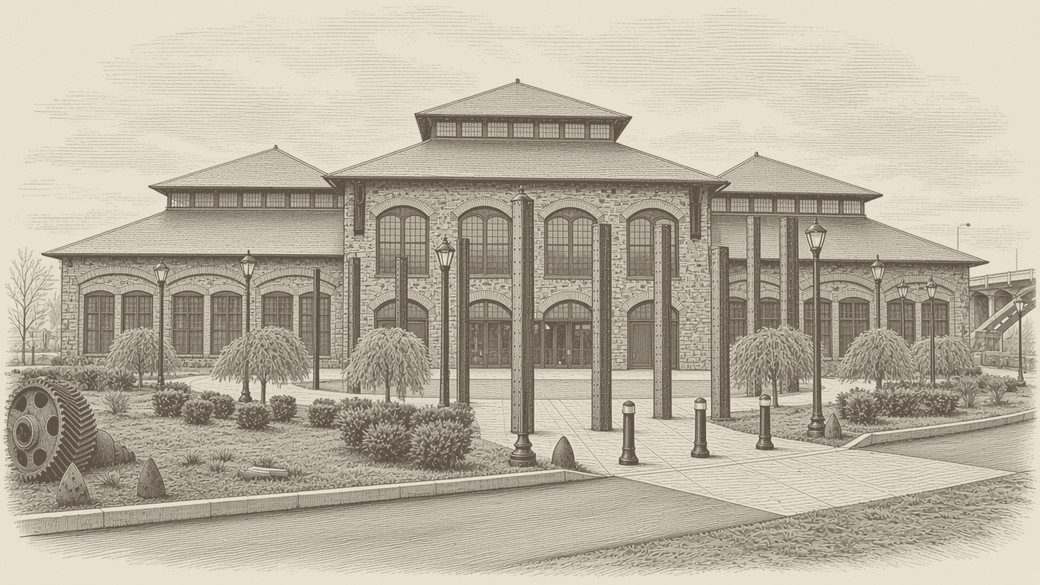
I've walked past the red Ferris wheel on Bridge Street a dozen times, and it took me way too long to ask why a wheel that doesn't turn is sitting in downtown Phoenixville. Then I walked a few blocks to the old Foundry at Main and Mill and noticed the row of iron posts out front.
I've walked past the red Ferris wheel on Bridge Street a dozen times, and it took me way too long to ask why a wheel that doesn't turn is sitting in downtown Phoenixville. Then I walked a few blocks to the old Foundry at Main and Mill and noticed the row of iron posts out front. Each one is a hollow tube with rivet seams running up the sides. Turns out the wheel and the posts are the same story. Both came out of a company that, for more than a century, basically was Phoenixville.
Nails on French Creek
Phoenixville starts with nails. Around 1790, Benjamin Longstreth set up the French Creek Nail Works on the flats where French Creek runs into the Schuylkill. The Historical Society of the Phoenixville Area calls it the first nail factory in the United States. The state marker on Main Street puts the start in 1783 instead, so the honest answer is the 1780s or 1790s. The works took the name Phoenix, the bird that rises out of fire, and the town growing up around it took the name too.
The Phoenix Iron Company
By the 1850s the works on French Creek was rolling iron rails, beams and plates, and in 1855 it was incorporated as the Phoenix Iron Company. The company built houses for its workers on its own land. The rows got nicknamed Nailer's Row and Puddler's Row, after the jobs of the men who lived there. The historical society says plainly that wages at Phoenix ran low and that company housing gave management more control over workers. Some of those houses still stand in Phoenixville today. They're private homes now, so look from the sidewalk and leave it at that.
Phoenixville goes to war
This is the part I keep thinking about this week. In 1855, John Griffen patented a new kind of wrought-iron gun. When the Civil War came, the government bought roughly a thousand 3-inch Ordnance Rifles from the Phoenixville works. Sources argue about the exact number, so roughly a thousand is the fair way to say it. Union batteries hauled them all over the war, including at Gettysburg.
Here's the detail that gets me. The rifles made in Phoenixville are stamped PIC on the muzzle, for Phoenix Iron Company. If you're at a battlefield this Veterans Day week and you see one, lean in and look. There's a decent chance it came from French Creek.
The column
The bigger idea came out of Phoenixville in 1862. Samuel Reeves patented the Phoenix column. Builders back then mostly used solid cast-iron columns, which are strong but brittle. Reeves's version took curved strips of wrought iron with flanged edges and riveted four, six or eight of them together into a hollow tube. It was lighter than solid cast iron and stronger.
That's a big deal for a hollow post. Phoenix columns went into railroad bridges, viaducts, elevated train lines and city buildings, and they helped make taller buildings and longer bridges possible. The company made them until 1919. A sister outfit, the Phoenix Bridge Company, built bridges with them for decades.
Steel, then quiet
Phoenix started making steel in 1889, and the plant kept a big part of the town working well into the 20th century. Then bigger mills and cheaper competition caught up with it. The historical society says the last heat of steel in Phoenixville was poured in 1976. Other sources put the end in the 1980s, and the state marker says the company closed in 1987. Most of the plant came down after that.
What's still standing on Main Street
Two buildings made it: the company office and the Foundry. The Foundry went up in 1882, a brick and stone hall at Main and Mill of about 14,000 square feet, with its big wooden crane still inside. After a restoration done with National Park Service guidance, it's now the Schuylkill River Heritage Center, a small museum about the ironworks and the river.
Those columns out front have their own trip behind them. They were salvaged from the Stegmaier Brewery and brought back to the town that came up with the design. I love that. Somebody saved a pile of old posts and drove them home.
The wheel comes home
And the wheel on Bridge Street. In the 1890s, the Phoenixville company built a big wheel for The Palace amusement hall in Asbury Park, New Jersey. It spun there for close to a century. After The Palace closed it went to Biloxi, Mississippi, then into storage in Tinton Falls, New Jersey.
In 2008 a Heritage Center volunteer, Barbara Cohen, started asking whether it was really a Phoenix wheel. It was. Phoenixville took over a lot at 381 Bridge Street in 2019, landed a $750,000 state grant, chipped in $350,000 of its own, and a community donor covered the rest of a bid of more than $2.1 million. The rebuilt wheel was dedicated this June. It doesn't carry riders. The borough and the Heritage Center bill it as the oldest surviving Ferris wheel in the world. It came home to the town that made it.
How to see it this weekend
The Phoenix Wheel is on Bridge Street at number 381, and you can see it any time. The Foundry and the column arc are at 2 N. Main St. The Schuylkill River Heritage Center inside is open Friday, Saturday and Sunday, 11am to 3pm, so this weekend works. I couldn't find an admission price online, so call 610-935-2181 before you go. The state historical marker is on Main Street by the Mill Street lot.
Phoenixville named itself after a bird that rises out of fire. The furnaces are long gone, but the iron is still standing all over town once you know which posts to look at.